


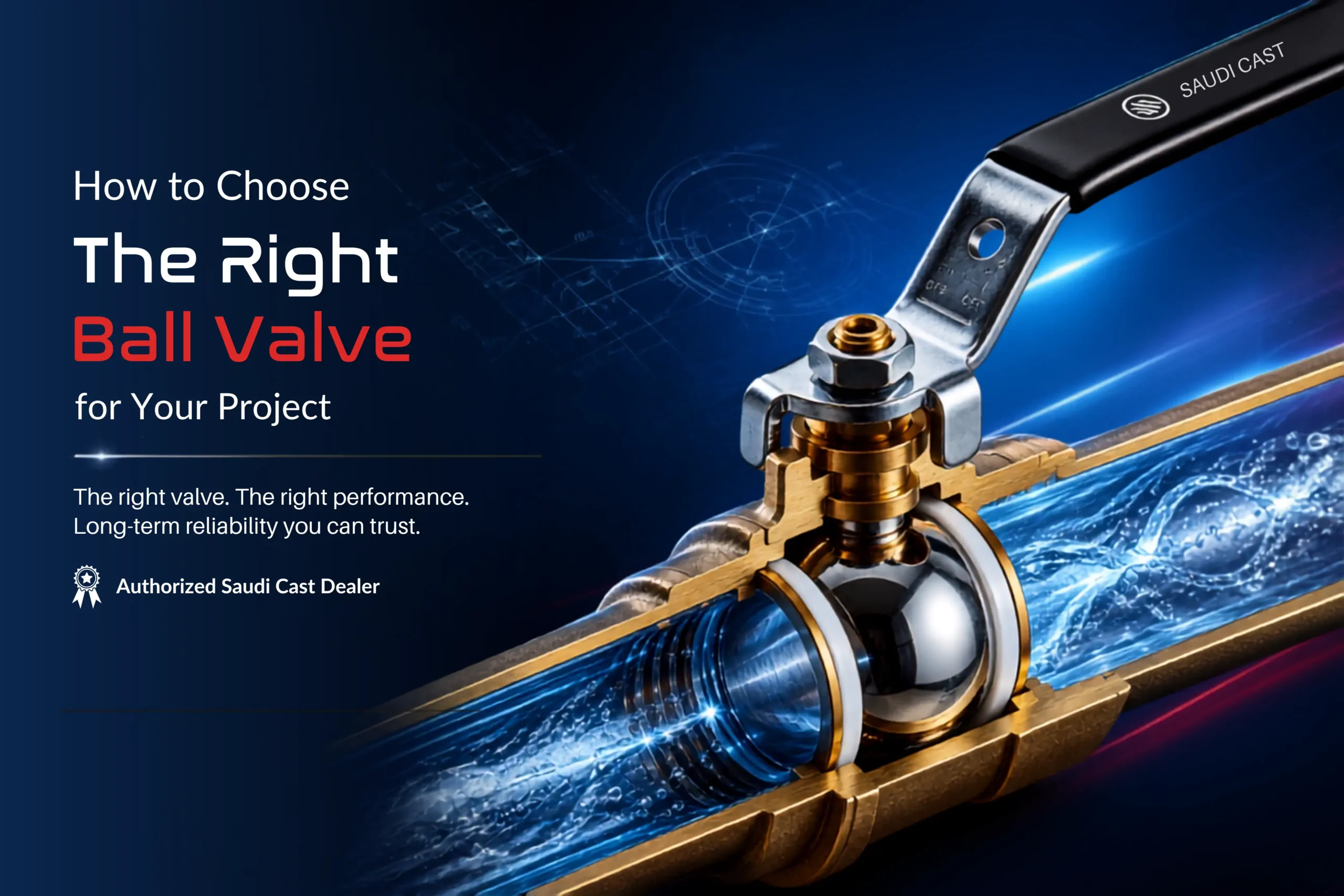
Ball valves are among the most widely specified components in plumbing, HVAC and industrial piping systems. They are compact, they shut off quickly and positively with a quarter turn, and a full-bore valve passes flow with very little restriction when open. But “ball valve” is a family, not a product: size, body material, bore, connection and rated duty all vary, and a valve chosen on price or availability alone can be wrong for the line it lands in. This guide walks through the checks procurement teams and contractors should make before ball valves go onto a BOQ — and closes with the valve and fittings currently listed in the Fanoos range.
1. Start with the system’s design conditions
Every ball valve carries a manufacturer rating for the pressure and temperature it is designed to work within. The selection rule is straightforward: the valve’s rated limits, taken from its datasheet, must cover the system’s design conditions with the margin the project specification requires. The errors happen when the rating is assumed instead of checked — a valve carried over from a previous project, or substituted at procurement stage, may have a lower rating than the line it is installed on. Put the design pressure and temperature on the BOQ or RFQ line, and ask the supplier to confirm the offered valve’s rating against them in the submittal documents. Never accept a rating from memory or from a catalogue headline; the datasheet for the exact model is the only reliable source.
2. Choose the body and seat material for the fluid
Body material determines how the valve stands up to the fluid, the environment and the service regime. The seat material matters just as much: the seat forms the seal around the ball, and an incompatible seat will leak or degrade long before the body shows any problem. Check both against the fluid being handled, and confirm them with the supplier for chemical, chilled-water, hot-water or drainage-adjacent duties.
| Material | Commonly used for | What to confirm |
|---|---|---|
| Brass | Domestic and commercial water plumbing | Rating and seat compatibility for the line’s temperature |
| Stainless steel | Corrosive fluids and hygiene-sensitive services | Grade and rating against the project specification |
| PVC / uPVC | Plastic pipework, chemical and drainage lines | Temperature limits — plastic valves are not for hot lines |
3. Full bore or reduced bore
A full-bore (full-port) valve has an internal passage matching the connected pipe, so when open it adds minimal restriction and minimal pressure loss. That matters on lines where flow rate is critical or where the design pressure drop has no spare allowance. A reduced-bore valve has a smaller internal passage: it costs less and is perfectly acceptable for isolation-only duties and low-flow branches, but it is a deliberate restriction in the line. The BOQ should state which type each line needs; leaving it open invites the cheaper option by default, whether or not the hydraulics allow it.
4. Size and connection type
Valve size follows the line size, but the connection must be confirmed against the approved drawings, not assumed. Threaded, flanged and press-fit connections all exist across ball valve ranges, and a mismatch discovered at installation is a pure delay: the valve is on site, paid for, and unusable. Record the connection type per line in the BOQ, and where the project mixes connection systems — a common situation where new work ties into existing pipework — flag the transition fittings on the same schedule so they are procured with the valves, not after them.
5. Operation and access
Isolation valves only work if someone can reach and operate them. Check the operating clearance for lever handles at each valve position, and identify any valves that will sit above ceilings, inside shafts or behind access panels — those locations need to be agreed with the other trades before installation, not negotiated afterwards. On larger lines or where valves are operated frequently, confirm the operating arrangement the specification calls for at BOQ stage. Finally, walk the isolation logic once: every section of pipework that may need future maintenance should be isolatable without draining the whole system, and the valve schedule should show it.
Tagging is part of the same discipline. Give every valve a unique tag on the schedule that survives onto the installed label, so that the valve approved in the submittal, the valve delivered to site and the valve shown on the as-built drawings are provably the same one. On projects with dozens of near-identical valves, the tag is what turns a future maintenance shutdown from a search into a lookup.
6. Documents and approvals
For government, industrial and larger commercial projects, valves are typically part of the material submittal, and approval can gate the order. Request the datasheet for the exact model — showing its rating, materials and dimensions — at quotation stage rather than after award. Where the project specification names particular standards or approvals, list them in the RFQ and ask the supplier to confirm, in the submittal, how the offered valve meets them. Advance paperwork is unglamorous, but it is what prevents a compliant system design being delayed by an undocumented component at handover and inspection.
The brass ball valve in the Fanoos range
Fanoos lists a Brass Ball Valve in its Valves range: a brass-bodied ball valve in sizes from 1/8 inch through 4 inch, covering the small-to-medium line sizes that make up most plumbing isolation and branch duties. If your BOQ calls for brass ball valves in that size band, send the schedule — with the design pressure and temperature for each line — through the quote route below, and the rating and document confirmation described in sections 1 and 6 can be covered in the response. No rating is stated here deliberately: as this guide argues, ratings belong in the datasheet for the duty, confirmed line by line, not in marketing copy.
Plastic lines: PVC fittings in the same range
Projects with plastic pipework need the fittings to match the valves on the same schedule. Alongside its valves, Fanoos lists PVC pipe fittings under Plastic Pipes & Fittings, including the PVC Tee Equal Class 5 (sizes 16 mm to 400 mm) and the PVC Schedule 40 90° Elbow (sizes 1/2 inch to 8 inch). Listing valves and fittings on one RFQ — with sizes, quantities and the delivery city — keeps the plastic and valved sections of the system in one coordinated quotation instead of two separate procurements.
Get a quotation for your valve schedule
Fanoos AlHadeeth Trading Co. supplies valves, pipes and fittings for projects across Saudi Arabia from its base in Jeddah, on a quotation basis. Send your valve schedule or BOQ through the contact and quote form — select the Product Inquiry/RFQ enquiry type, include sizes, quantities, design conditions and the delivery city — or contact the team on +966546236905 / sales@backup.fanoosksa.com (Sat–Thu, 08:00–19:00).